Welcome to a little culinary adventure in the heart of Marrakech, where we’ll explore some of the most unusual —yet surprisingly delicious— foods that locals truly love. This isn’t about the tagines or couscous you see in every guidebook (which we adore and will explore in more detail in future articles). Instead, we’ll dive into the dishes that might make you pause, raise one eyebrow, or maybe even both, before you taste them and understand why they’re so cherished.
Many travelers are often surprised to discover that Moroccan cuisine goes far beyond the dishes typically found in tourist spots. It’s one of the world’s richest and most diverse culinary traditions, with foods that may seem unusual at first but carry deep history, clever preservation methods, and flavors that are profoundly comforting to those who grew up with them. Ironically, these same dishes are often the ones that leave the most lasting impressions on visitors from around the globe.
This article is the first in our “What Locals Eat in Marrakech” series, where we’ll slowly uncover the foods, snacks, and daily rituals that make local dining truly unique. Think of it as a peek into everyday life here, through the lens of what people actually eat, not just what looks pretty on restaurant menus.
So, let’s begin. Some of these dishes might surprise you, but they’ll make sense once you understand why they matter, and why locals keep coming back for them.
1. Khlii with eggs
Khlii is one of those foods travelers almost never encounter unless someone introduces it and explains what it is. And even then, it can feel a little mysterious at first.
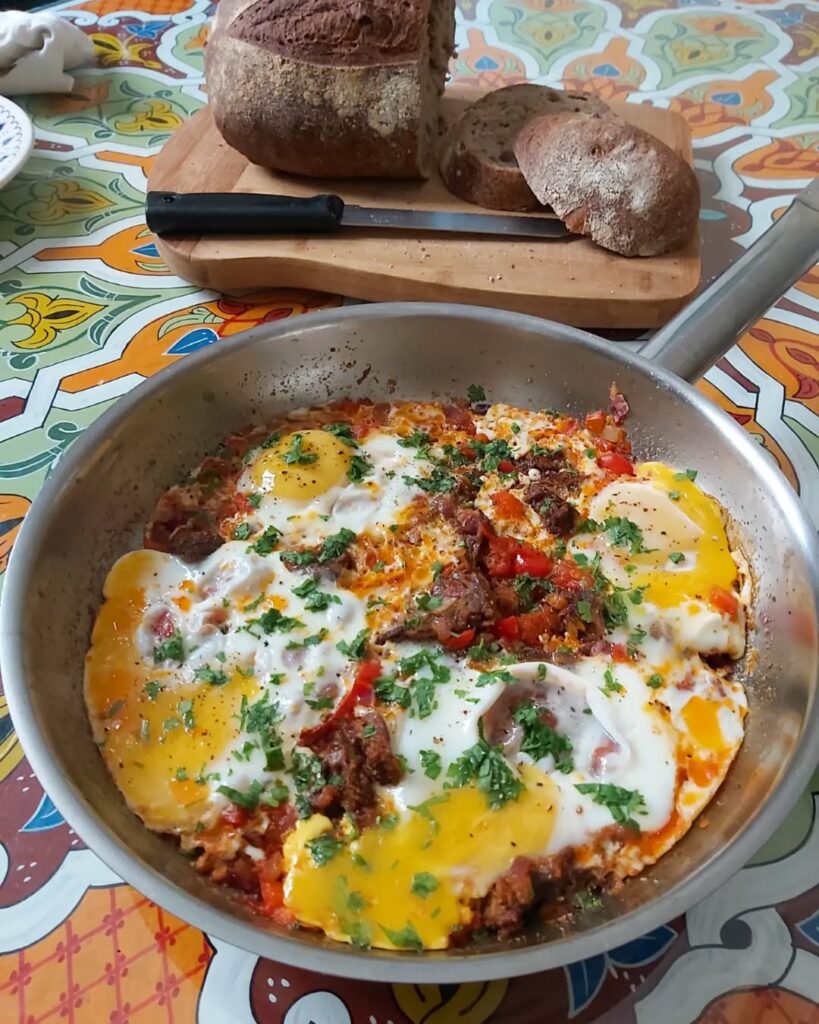
In essence, khlii is preserved meat — usually beef or sometimes lamb — salted, spiced, dried, and stored in fat. The preservation method historically mattered a lot, allowing families to keep meat for months without refrigeration. The flavor is intense, rich, and deeply savory.
The most common way locals enjoy khlii is at breakfast, fried lightly with eggs.
Many visitors are surprised by that combination, but in practice it’s hearty and grounding, especially on cool mornings.
Beyond eggs, khlii can also appear in slow-cooked tagines, stirred into couscous for extra depth, or simply served with bread for a simple snack. It’s versatile, but always used sparingly, more like a seasoning or a flavor enhancer than a main protein.
Quality varies, and you usually won’t find it in supermarkets. The best khlii is homemade or purchased from trusted butchers. When done well, even a small amount goes a long way, offering a taste that is both comforting and uniquely Moroccan.
2. Sardine kefta
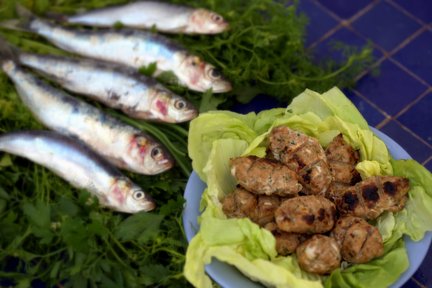
Sardines might not be the first thing travelers expect when they think of Moroccan food, but in Marrakech — and along the Atlantic coast — they are a real staple. Sardine kefta takes these humble fish and transforms them into spiced meatballs, often grilled or lightly fried, usually served with a bit of bread or a simple salad.
The seasoning is simple but precise: fresh parsley and cilantro, garlic, a touch of paprika, cumin, and sometimes a hint of preserved lemon. These herbs brighten the natural flavor of the fish, while the spices give just enough warmth without overpowering it. Many visitors are surprised by how mild and approachable the flavors are. In practice, it tastes delicate and fresh, with a savory depth that’s a little like a lightly herbed tuna burger, but softer, tender, and unmistakably Moroccan.
Unlike heavier meats, Sardine kefta feels light yet satisfying, perfect for a quick lunch or an afternoon snack.
Beyond meatballs, sardines appear in several other local preparations: grilled over open coals, baked stuffed with chermoula, preserved in oil with garlic and spices, or layered into simple tagines. They’re versatile, economical, and deeply woven into the rhythms of local life; which makes trying sardine kefta less about daring and more about appreciating the fresh, everyday flavors that Moroccans love.
3. Seffa Medfouna
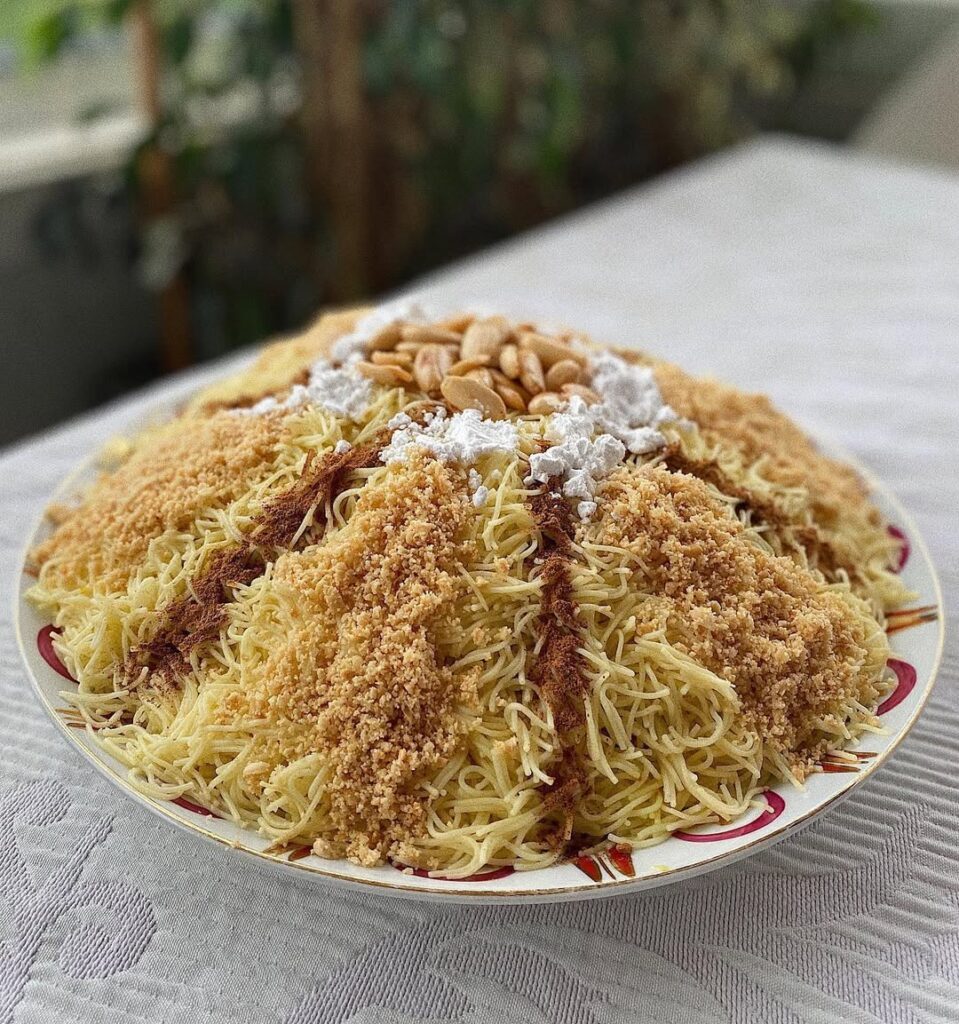
At first glance, Seffa Medfouna might confuse travelers. It looks sweet — a delicate mound of steamed fine vermicelli dusted with powdered sugar, cinnamon, and scattered almonds. But buried inside is usually tender chicken or sometimes pigeon, slowly cooked until soft and flavorful. The combination might surprise you, but in practice, the sweetness and savory meat complement each other beautifully, a balance that we Moroccans have proudly and humbly perfected over generations.
Seffa isn’t an everyday dish; it’s more common at special brunches, family gatherings, or celebrations. The powdered sugar and cinnamon aren’t just decoration.. they add warmth and a comforting aroma, and the almonds give texture and a little richness. From our perspective, trying Seffa Medfouna is as much about savoring the flavors as it is about understanding how Moroccans enjoy layering tastes in a single dish.
In taste and texture, it’s a bit like a sweetened rice pilaf or a lightly spiced bread pudding — sweet, nutty, lightly spiced, with a gentle, satisfying surprise hidden inside. Portions are generous but not overwhelming, and it’s meant to be shared, often with tea.
When you look deep into it, Seffa Medfouna is a quiet reminder of the Moroccan approach to flavor: simple ingredients, carefully balanced, patiently prepared, and often tied to family, season, and tradition.
4. Babbouche (Snail Soup)
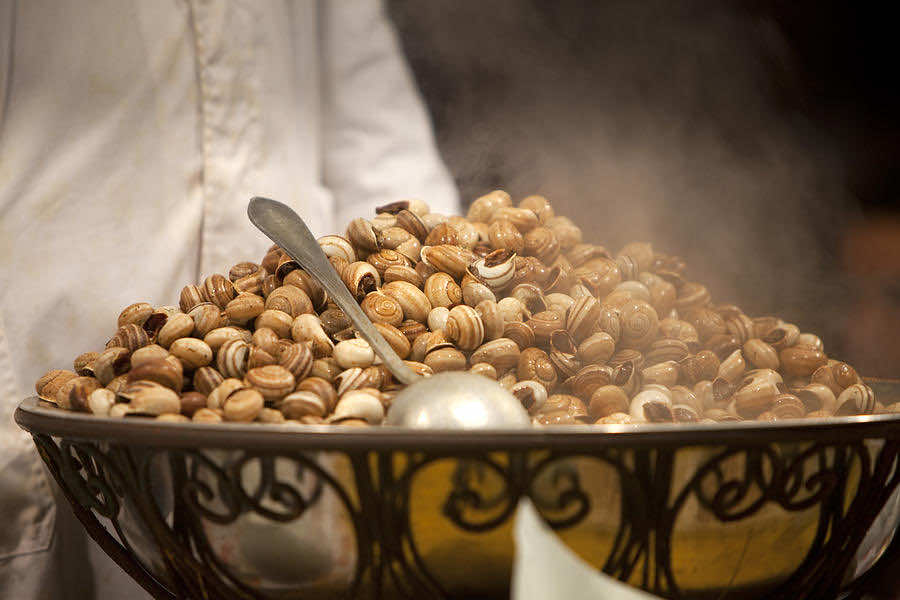
If you walk through the streets of the Medina of Marrakech (or other popular neighborhoods like Daoudiate) in the evening, you’ll notice a rich, herbal aroma drifting from small carts — that’s babbouche, or snail soup. At first glance, it might make some travelers hesitate, but for locals, it’s a beloved street food, combining flavor and tradition in one steaming bowl.
The soup itself is a slow-simmered, intensely spiced broth, usually flavoured with thyme, aniseed, mint, and sometimes a pinch of chili or cumin. The snails add a chewy, earthy bite, and many Moroccans enjoy the snails first, sipping the broth at the end. Some even prefer to buy the broth on its own, enjoying its fragrant, herbal flavors without the snails. It’s actually the broth that makes the dish magical: rich, complex, warming, and surprisingly comforting on a cool evening.
Babbouche carts often serve the soup with small skewers or toothpicks for picking out the snails, and sometimes a squeeze of lemon to brighten the flavors. Beyond taste, babbouche carries a cultural layer: it’s believed to have medicinal benefits, from boosting energy to soothing minor ailments, which is why you’ll often see locals slurping it late at night.
One question that comes up regularly is about hygiene, which is understandable. Our recommendation is usually to choose a busy stall where turnover is high — snails that sit too long lose their appeal even for locals. When done well, the broth is deeply aromatic, and the snails are tender rather than overly chewy.
If you’re curious but hesitant, sharing a small bowl is a good way to try it without pressure.
If you want to taste snail soup in safe hands, we offer it on one of the two itineraries of our Authentic Moroccan Food Tour. We’d be very happy to have you try it first with us!
5. Sheep’s Head (Lham Rass)
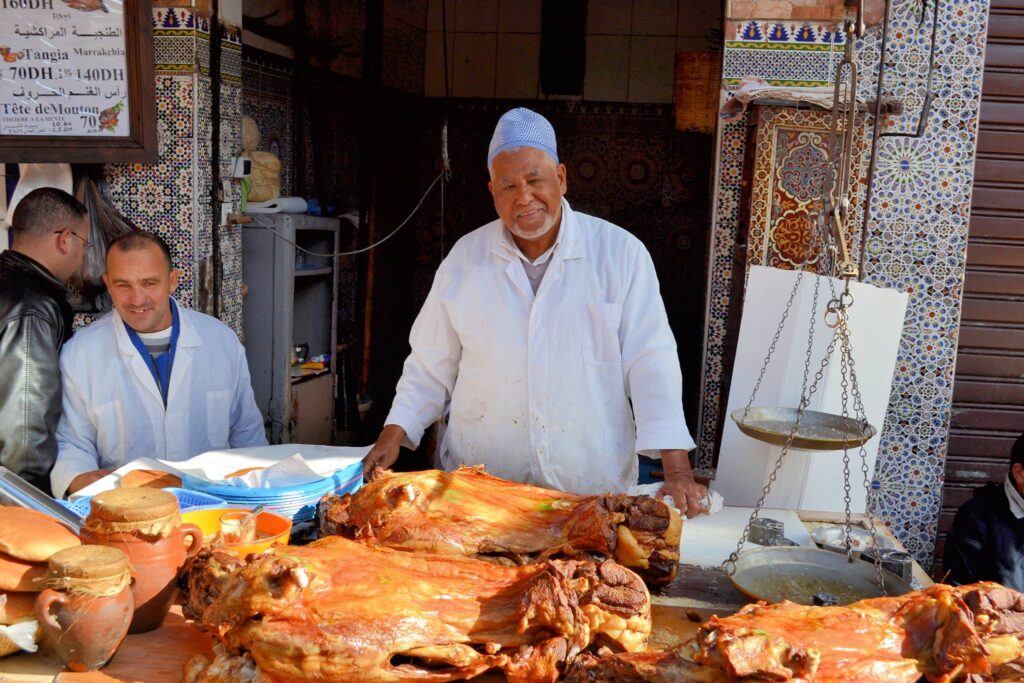
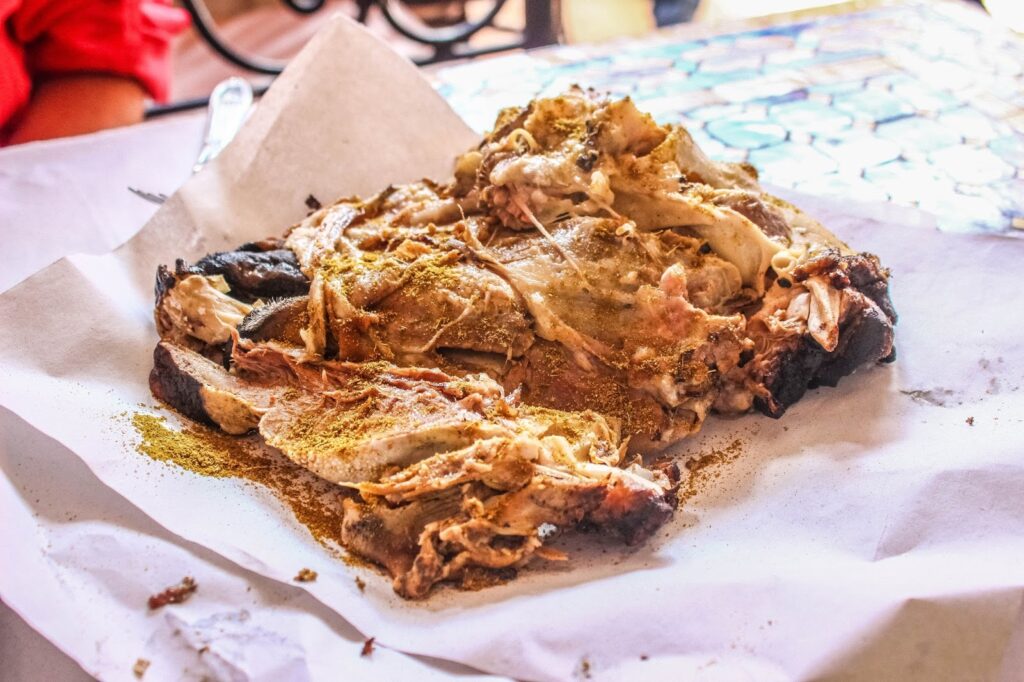
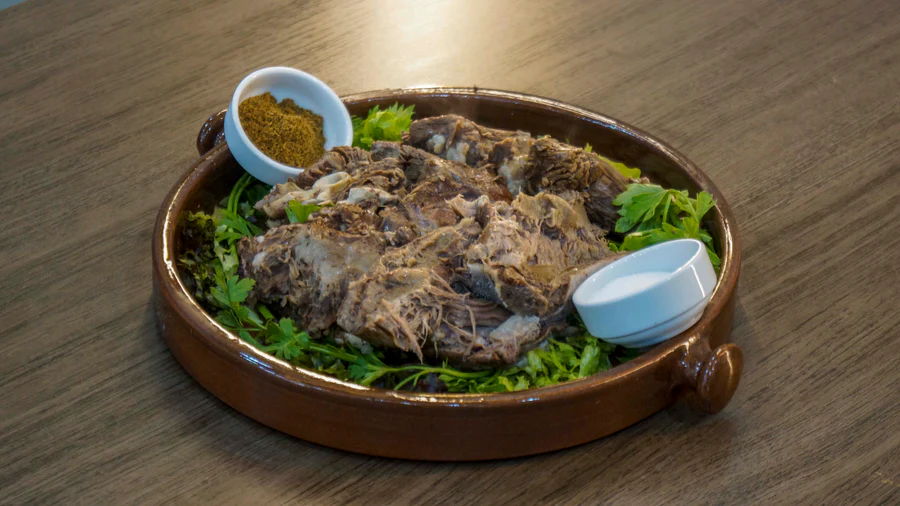
Lham Rass, literally “head meat,” is one of those dishes that often stops travelers in their tracks. A whole sheep’s head is slow-cooked, usually steamed or roasted, then split and served simply with salt and cumin. It doesn’t try to look elegant, and it isn’t meant to. For locals, this is comfort food, not a spectacle.
This dish is especially common after Eid al-Adha, when families share meat from the sheep they’ve sacrificed. Eating the head is part of using the whole animal, something that still matters deeply for us. In practice, the meat is much milder than people expect — soft, moist, and surprisingly delicate. The cheeks are tender, the tongue smooth, and each part has its own texture.
Lham Rass is usually eaten slowly, by hand, piece by piece. There’s no sauce, no garnish, just cumin, salt, and bread. That simplicity is intentional. What usually surprises people most isn’t the flavor, but how comforting and satisfying it feels once they get past the idea of it.
Many visitors, especially from Western countries, assume this dish is about bravado or shock value. It isn’t. It reflects a deep respect for food, which is traditionally considered a blessing from God. Wasting edible parts is seen as a lack of gratitude, and using everything carefully is a way of honoring both the food and the privilege of having it.
This isn’t a dish you’ll find everywhere, and quality matters a lot. Locals tend to go to very specific places they trust. You won’t usually encounter it in tourist restaurants. When you do see it — often at local grills — it’s eaten calmly, without ceremony. Not everyone, even locally, enjoys or seeks it out. But those who love it really love it.
If you're curious to try Sheep's head during your stay in Marrakech, it's one of the key stops we offer on one of the two itineraries of our Authentic Moroccan Food Tour.
6. Kouraine (Cow's feet)
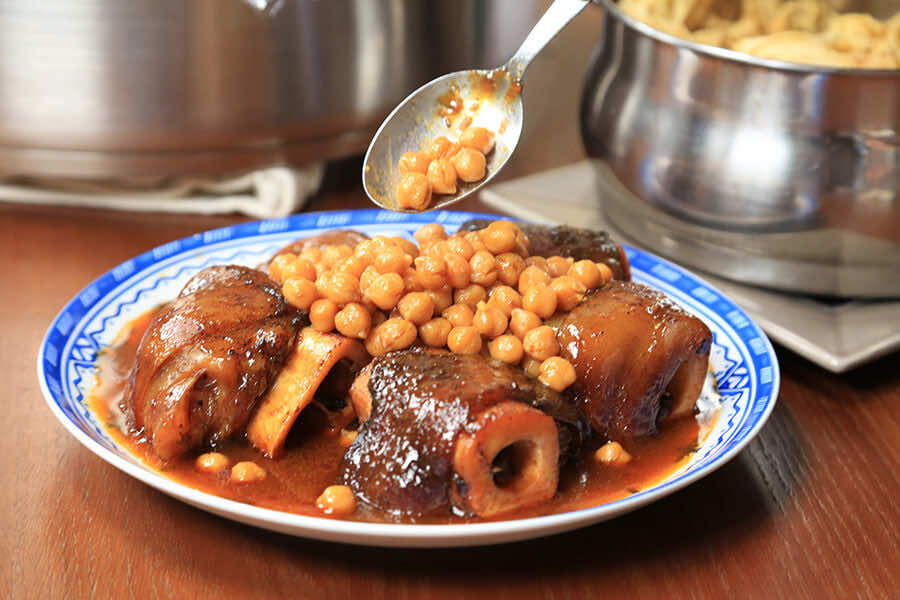
Let’s talk about a dish that you’ll rarely find on menus, and almost never in tourist restaurants. Kouraine is a rich, traditional Moroccan stew made from cow’s feet, chickpeas, and a fragrant blend of spices like cumin, ginger, turmeric, saffron, and paprika. The result is hearty, flavorful, and unique, a dish commonly prepared during holidays or served as a breakfast snack in popular neighborhoods.
It’s closer to a thick, gelatinous stew, where the long cooking draws out collagen and turns the liquid rich and almost sticky. The feet are simmered for hours with garlic and spices, until the meat becomes tender and the broth naturally thickens. There’s no attempt to mask the ingredient or make it fancy. When done well, the flavor is mild, deeply savory, and comforting, with a richness that comes from patience rather than fat.
Kouraine is traditionally eaten in the morning (yes, as breakfast) or around midday, especially during colder months. It’s considered strengthening food, something that gives energy and warmth rather than indulgence. It's often presented with chickpeas, and we eat it with bread (not spoon!).
Kouraine is traditionally eaten in the morning (yes, as breakfast!) or around midday, especially in colder months. It’s considered strengthening food, something that gives energy and warmth rather than indulgence. It’s often served with chickpeas, and we eat it with bread — not a spoon!
Like most dishes made from less familiar cuts, quality matters a lot. It’s usually prepared in small local spots that know how to cook it properly. When rushed, it can be unpleasant; when done well, it’s tender, balanced, and quietly satisfying.
Kouraine reflects a very practical side of Moroccan food culture: using humble cuts, cooking them slowly, and valuing nourishment over presentation. It’s not for everyone, and no one expects it to be. But for those curious enough to try it, it offers a very honest taste of everyday food culture in Marrakech.
7. Tihane (Calf Spleen)
This one is truly “weird” for many visitors.
By now, we hope you realize that Moroccan cooking has a long tradition of organ meats: they're prepared thoughtfully, with care, rather than hidden or overlooked.
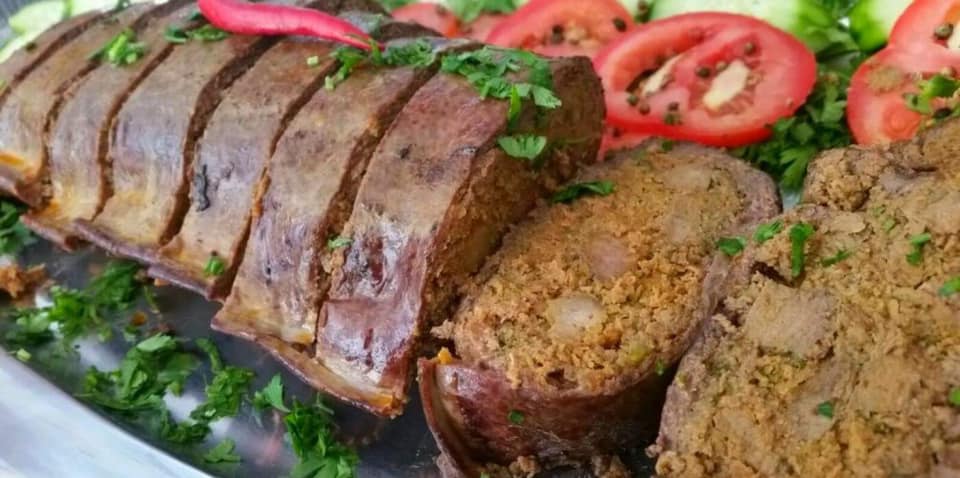
Tihane is a traditional Moroccan street food, made of spiced ground meat (beef or lamb) mixed with rice and herbs, stuffed inside a spleen (usually beef or calf’s), then roasted and served sliced. Think of it like a very large sausage, served in slices much like meatloaf.
You’ll usually find the best-quality tihane at grills set up next to well-reputed butcher shops... places with high turnover, where only a few slices might be left at a time, and locals are constantly ordering.
Some Marrakchis love this dish and consider it a delicacy, especially offal enthusiasts. That said, it’s not for everyone. In our opinion, it’s the most adventurous one on this list, so we encourage you to listen to — and trust — your instincts. It just might delight your palate.
8. Maakouda
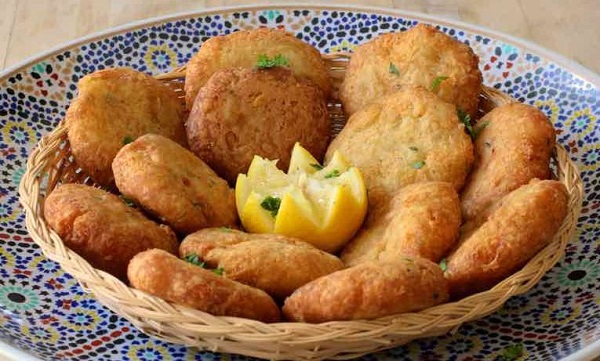
Moving on to a simple, humble, and surprisingly beloved street food: Maakouda. These are small, golden potato fritters, lightly spiced with garlic, parsley, and sometimes a touch of cumin or paprika. Crispy on the outside and soft and pillowy on the inside, they’re usually eaten hot, on the go, straight from street stalls — as a snack, an appetizer, or tucked into sandwiches with local spicy chili sauce.
What makes them special isn’t just the flavor, but the way locals eat them. Fresh from the fryer, they’re best enjoyed immediately, with the crisp giving way to the warm, tender interior. They’re approachable, comforting, and perfectly satisfying. Humble ingredients transformed with simple care and technique. Even travelers who think they’re “just potatoes” often end up going back for seconds, and it’s easy to see why after tasting them.
9. Tkalya (Sheep Tripe)
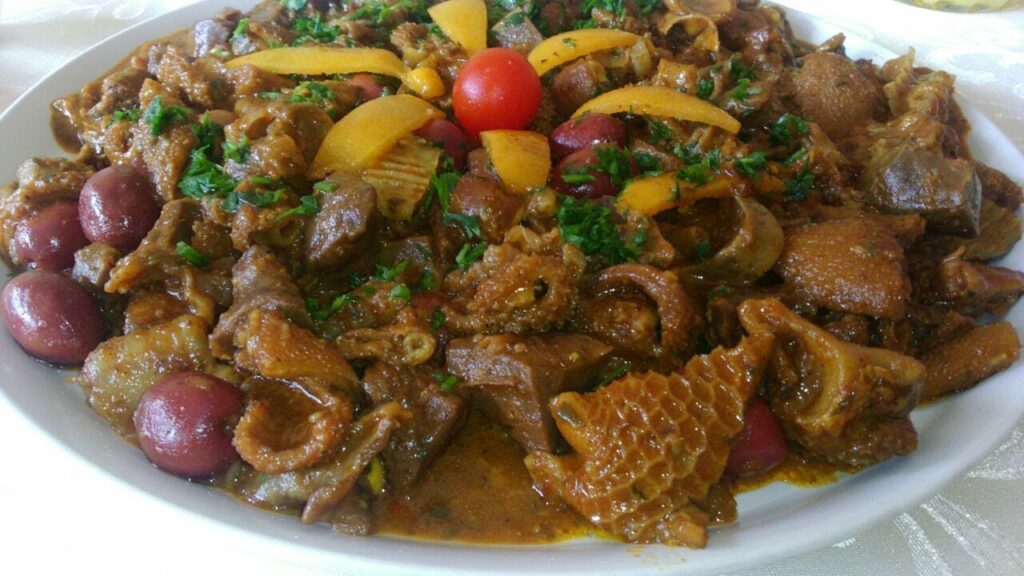
Moving on to a true Moroccan classic, and the big one on this list: Tkalya, also called Dawara. This dish is closely tied to Eid al-Adha, when families celebrate the sacrifice with meals that honor every part of the animal.
Tkalya is made from lamb tripe, intestines, lungs, liver, and heart, meticulously cleaned and cut into small pieces. It’s slowly cooked with olive oil, onions, garlic, and a fragrant blend of spices — turmeric, cumin, paprika, and ginger — until everything melds into a rich, aromatic sauce. Preserved lemon, olives, and fresh parsley and coriander are added near the end, giving the dish brightness and lift.
The first bite is a revelation. The tripe is tender but slightly chewy, the lungs and intestines melt in your mouth, and the liver and heart add depth. The sauce is thick, warmly spiced, and tangy from the preserved lemon, lingering long after the meal. We, locals, often enjoy it with a Coke (Coca-Cola), or a glass of Oulmès mineral water, which is widely believed to help with digestion after such a rich dish.
Like Kouraine, Tkalya is traditionally served for breakfast or lunch in popular neighborhoods. It’s hearty, comforting, and deeply satisfying — the kind of dish that fills both the stomach and the senses.
Given the organs involved, quality is especially important with Tkalya. The most trusted restaurants and spots are those where locals know the cooks take their time cleaning everything thoroughly and follow careful hygiene practices during preparation.
One final note: we were surprised to discover how little Tkalya is mentioned outside Morocco. There are almost no blogs or international food sites writing about it, despite it being a cornerstone of Moroccan culinary tradition. It’s a hidden gem of flavor, history, and celebration that you won’t find in most tourist guides. So, we’re proud to be one of the first English-language sources to present this amazing delicacy to the world. 🙌
10. Khobza Ajiba (Majnouna)
Finally, we’ll end with something you definitely won’t find on blogs or in guidebooks: Khobza Ajiba, also called Majnouna. The name literally means “crazy” or “mad sandwich,” and once you try it, you’ll understand why. It was first created by a street vendor in the Medina of Marrakech and quickly became popular across the country.
The fillings are a glorious, chaotic mash-up: fluffy boiled potatoes and tender rice, slices of boiled egg, briny green and black olives, chunks of Moroccan mortadella (a local deli meat made from chicken, beef, or turkey), flaked tuna, cheese, all slicked with a smear of mayonnaise or ketchup. Each bite is a surprise: soft, salty, creamy, and slightly tangy, with flavors and textures colliding in the best possible way. It’s messy, bold, and wildly satisfying — just the kind of madness the name promises.
Khobza Ajiba is beloved because it’s deeply filling, affordable, and accessible — perfect for a quick breakfast, lunch, or snack on the go. Served hot and freshly made, the real challenge is finding a vendor who cares about hygiene and preparation. When you do, the sandwich is absolutely delicious.
The truth is, this humble yet mad sandwich is loved by almost everyone. In Marrakech, we like to say that Khobza Ajiba has so much goodness inside that it feeds both the rich and the poor alike. Give it a try. It might completely win you over.

Closing thoughts...
If you’ve made it this far, one thing should be clear: locals in Marrakech don’t eat for Instagram.
They eat what’s filling, what’s familiar, what their parents cooked, what their neighbors swear by, and what tastes right at 8 a.m., midnight, or the day after Eid. Some of these dishes look strange. Some smell intense. A few might make you hesitate. That’s exactly the point.
Moroccan food culture isn’t about hiding ingredients or softening flavors for outsiders. It’s about using everything, cooking it properly, and enjoying it without apology. Sheep’s heads, snails, spleen, tripe, cow’s feet, “crazy” sandwiches — none of this is shocking here. It’s normal. Comforting. Sometimes even nostalgic.
You don’t need to try everything on this list. Really. We don't expect you to. But try just one dish you didn’t expect to like, and you’ll understand Marrakech far better than someone who ate tagine every night and thought they’d cracked Moroccan food. As for eating KFC or McDonald’s here every day… let’s just pretend no one does that.🙈
This is only the first chapter of our What Locals Eat in Marrakech series. We explored 10 of the “weirdest” and most unusual foods locals actually love. Next up: everyday favorites, breakfasts that will surprise you, late-night street eats, mouthwatering tagines, and much more to expand your taste and your understanding of Moroccan cuisine.
Eat curious. Eat brave. And let your taste buds do the exploring — and judge. 😌